Tired of being lectured on politics by rock stars and celebrities in general? Take a look at this diatribe on TCS Daily.
Memo to Steve Earle: I still love you!
Tuesday, October 31, 2006


Wednesday, October 18, 2006
How to Build a Laser Gun -- The Latest!
The laser-gun conspiracy I've written about before continues to spread. Every day I get more hits on this website from people around the world looking for information on how to build a laser gun.
Today, persons unknown in Iran, Turkey and Colorado all typed the words "build a laser gun" into Google and then linked to my site. I'm not sure which scares me the most.
Here's the proof, courtesy of Site Meter:
Domain Name (Unknown)
IP Address 85.185.64.# (Shabeke Gostar Company ,Internet Service Provider)
ISP Telecommunication Company of Iran (TCI)
Location Continent : Asia
Country : Iran, Islamic Republic of (Facts)
State/Region : Hamadan
City : Gostar
Lat/Long : 35.4667, 48.8833 (Map)
Language Farsi
fa
Operating System Microsoft WinXP
Browser Internet Explorer 7.0
Mozilla/4.0 (compatible; MSIE 7.0; Windows NT 5.1; .NET CLR 2.0.50727)
Javascript version 1.3
Monitor Resolution : 1024 x 768
Color Depth : 32 bits
Time of Visit Oct 18 2006 6:01:30 am
Last Page View Oct 18 2006 6:01:30 am
Visit Length 0 seconds
Page Views 1
Referring URL http://www.google.co...fa&q=build laser gun
Search Engine google.com
Search Words build laser gun
Visit Entry Page http://winneker.blog...build-laser-gun.html
Visit Exit Page http://winneker.blog...build-laser-gun.html
Out Click
Time Zone UTC+2:00
Visitor's Time Oct 18 2006 1:31:30 pm
Visit Number 4,114
...developing...
Today, persons unknown in Iran, Turkey and Colorado all typed the words "build a laser gun" into Google and then linked to my site. I'm not sure which scares me the most.
Here's the proof, courtesy of Site Meter:
Domain Name (Unknown)
IP Address 85.185.64.# (Shabeke Gostar Company ,Internet Service Provider)
ISP Telecommunication Company of Iran (TCI)
Location Continent : Asia
Country : Iran, Islamic Republic of (Facts)
State/Region : Hamadan
City : Gostar
Lat/Long : 35.4667, 48.8833 (Map)
Language Farsi
fa
Operating System Microsoft WinXP
Browser Internet Explorer 7.0
Mozilla/4.0 (compatible; MSIE 7.0; Windows NT 5.1; .NET CLR 2.0.50727)
Javascript version 1.3
Monitor Resolution : 1024 x 768
Color Depth : 32 bits
Time of Visit Oct 18 2006 6:01:30 am
Last Page View Oct 18 2006 6:01:30 am
Visit Length 0 seconds
Page Views 1
Referring URL http://www.google.co...fa&q=build laser gun
Search Engine google.com
Search Words build laser gun
Visit Entry Page http://winneker.blog...build-laser-gun.html
Visit Exit Page http://winneker.blog...build-laser-gun.html
Out Click
Time Zone UTC+2:00
Visitor's Time Oct 18 2006 1:31:30 pm
Visit Number 4,114
...developing...
Friday, October 13, 2006
Belgo-American Relations
The Bulletin, Brussels' expat weekly magazine, asked me to chart the history of US-Belgian relations, and try to figure out how one of Europe's most pro-American countries became decidedly less so. I took a stab at it.
A Special Relationship
By Craig Winneker
It wasn’t easy for an American eight-year-old to adjust to life in Belgium in the mid-1970s. For one thing, there was no peanut butter.
Not to mention no McDonald’s, few TV shows in English other than the occasional episode of “The Six Million Dollar Man”, schoolteachers with funny accents and disturbingly little sunshine. I thought I’d never survive the three years my father’s employer, a soon-to-be-vilified American multinational, had posted us here. But I did, and returned to the US with a decent adolescent command of French, an early passion for travel, and an understanding that the world was bigger than just America.
Twenty-five years later, when I moved back to Belgium, much had changed. American products were plentiful here, even if supermarkets still weren’t open long enough to make them obtainable outside work hours. The expat community had grown exponentially, along with EU enlargement and globalisation in general, but there seemed to be fewer Americans. The weather? Well, at least it’s getting warmer.
No one seems to know for sure how many of us Yanks now live in Belgium; estimates from the US embassy and the Belgian government range anywhere from 10,000 to 30,000. When I lived here in the 1970s, the number tossed around was 40,000. American businesses back then tended to parachute in mid-level managers. Nowadays they hire locals.
Jim Begg is one of many Americans who moved to Belgium in that earlier expat era and who’ve made it a permanent home. He first came to Brussels in 1962 as a trainee with Culligan, the water-softener company (as in, “Hey, Culligan man!”) He eventually started his own advertising agency, and recently retired after selling it to a big international firm. He shuttles between his homes in Brussels and the South of France.
“I’m an American européanisé,” he says. “But people still say to me, ‘You sound so American!’ And I say, ‘Well, I am American.’”
It’s true that with his flat Midwestern accent, you might mistake Begg for someone just off the proverbial boat. But he’s been in Europe long enough (and has a Dutch wife, and two French-speaking Dutch-American kids) to have experienced the various ups and downs in the Belgian-American relationship.
Like me, he sees two high points, if you will, in the chart-line of US-Belgian solidarity: the aftermath of World War II and the days immediately following 9/11. Like me, he’s watched Europe’s good will towards America waver since the start of the Iraq war. And, like me, he thinks that this anti-Americanism is really only skin deep, that Belgium is still a welcoming place for Americans.
“There’s still a deep feeling here about America and about its values,” he says. “But there’s also a concern about where America is going right now. I’m often the ‘token American’ at dinner parties, and people always start questioning me about what’s going on in the US. They really want to know what the Americans are thinking.”
The implication there, though Begg doesn’t spell it out, is that they want to know what the hell the American administration is thinking – or not thinking, as the case may be.
But he also gets to see another facet of the Belgian view of America. Through his work with the American Overseas Memorial Day Association, Begg is involved in organizing annual ceremonies honouring the 14,000 Americans who died on Belgian soil during World War II. It’s in this work that he still feels Belgians’ love and appreciation for the U.S.
“I spend a lot of time in these small Belgian villages,” he says, “and it’s an amazing feeling, how pro-American these people are. They will never forget what Americans did for them.” He says mayors in small Belgian towns are doing their best to involve young people in the commemorations, so that they learn the history of Belgian-American friendship. Every year on the U.S. Memorial Day a group of schoolchildren from Waregem sing the American national anthem.
Belgians of a certain generation agree with this sentiment, but also see obvious changes in how America is perceived here. “When we speak of Americans we always say we’ll never forget what they did in World War II,” says Marie-Louise Toisoul, who has lived in Brussels her whole life and was in high-school when Allied (mostly British) troops liberated the city in September 1944 and when American soldiers fought the Battle of the Bulge in the Ardennes throughout that winter. She points out that many in her country are also aware of the food aid given by the US after both world wars, when many Belgians were starving.
But she acknowledges that the goodwill Belgians have traditionally had for Americans – certainly after the world wars, but also after 9/11 – has waned. “Our attitude has changed somewhat,” Toisoul says. “But the so-called ‘anti-Americanism’ is always directed at George Bush – not at the American people. Of course, there are certain sectors of the population who feel that all Americans simply want to dominate the world.”
Her husband, Jean-Pierre Storrer, notes that not everyone in Belgium these days knows what they know about America. “There’s a difference between those who remember the war and those who came after,” he says.
Part of it may have to do with the lopsided balance of power in the world. As Toisoul points out, with the fall of the Soviet bloc, the US is the only so-called hyperpower on the planet, so it’s a big target for criticism and resentment.
This attitude manifests itself in ways that range from merely annoying to somewhat disturbing. Yes, it’s amusing to watch dreadlocked, bongo-beating ULB students staging some anti-American demo even as they swig Cokes and wear vintage Nikes. And who can really get too upset about the occasional condescending remark at a cocktail party or meathead comment from a rock performer who shouts a Bush-related obscenity from the stage as a cheap applause line?
Or there’s the kind of finely textured sentiment offered up by Flemish singer Raymond Van Het Groenewoed., whose “Weg Met Amerika” (“Down With America”), released last year, attacked Yanks as “the cause of the general decay/Short-sighted thinking, loud talking/Sticking to one-liners forever” and advocated sticking “a hot pick up their ass”. One pro-American Flemish commentator wondered why Van Het Groenewoed hadn’t been arrested, as it is illegal in Belgium to incite hatred against people based on their nationality. Instead, the song was played on Belgian state radio.
But one experience I had will always stand out as especially surprising – and even a bit embarrassing. Two colleagues from the US were visiting me in early 2003 and I wanted to take them to dinner at Aux Armes de Bruxelles. This required running the Ilot-Sacre gauntlet of mediocre restaurants and their infamous barkers, who lure unsuspecting tourists by feigning multilingual geniality.
One of them was giving us his spiel when he heard us speaking American English. He quickly became angry and started shouting, “Why don’t you go drop some bombs on Iraqi children?” I informed him that this was not a good way to attract business, and suggested that perhaps we start the bombing by targeting his bordel of a restaurant. We continued on our way to a pleasant dinner, but I had to explain to my guests that this was by no means an indicator of the town’s mood.
Or was it? One American consultant in town thinks the anti-Americanism is getting worse in Belgium – “worse that it was two years ago even. Brussels is a little out of touch with the rest of the country. A lot of people here just want to join in on anything that’s anti-American. People in Brussels are right in the middle of the propaganda machine. It’s not the Belgians, it’s the kind of people who work in Brussels. It’s the Europeans.”
Well, what about the Belgians? “I love the American people,” says Toisoul. “But it’s true that they often believe that America is the best at everything and nothing from anywhere else is any good.” True, I tell her, and isn’t that one of the ways we are so very like the French or the Italians?
American Michael Steinman is a relative newcomer in Belgium, having lived here for 18 months, but isn’t a part of the Brussels or Antwerp expat scene. He’s a sergeant in the US Army, based in Mons, where he is a trombonist in the SHAPE international band and NATO jazz orchestra. In addition to his military service, which takes him all over Europe, he plays a lot of music on the side, interacting often with jazz-loving Belgians.
“The musicians I meet are almost always enthusiastic and we have a great time on and off the bandstand,” he says. “I feel accepted by them, and as an American jazz player, they are really happy to play with what they consider to be the ‘real thing’. They have never brought up US policies or politics or the fact that I’m a service member in any negative way.”
Steinman does, however, confirm the common view among expats that it is hard to get close to the natives. Belgians are family oriented and not known for being especially warm to strangers – understandable for a country that has for centuries played unwilling (or at least reluctant) host to them. After a hard day at work speaking two or three languages that aren’t your mother tongue, you deserve some down-time.
“I barely know my neighbours,” says Steinman. “I’ve heard that in Belgium you can live 20 years in a house and never see the inside of your neighbour’s house. And I guess it’s kind of true. We say ‘bonjour’ to each other and chit-chat, but always outside in the street. They seemed taken aback when I invited a few in for beers once.”
Despite the well-known coolness to outsiders that its people exhibit, Belgium was once among the most pro-American countries in Europe. Belgians loved everything American – even things we shouldn’t be proud of introducing to them, like instant coffee. (“Oh, Nescafé, that was such a revelation!” gushes Toisoul.) They loved our hamburger meat so much they didn’t want to spoil it by cooking it. They bought our big Yankee cars – tailfin Chevys and stretch Cadillacs, even Buicks.
Toisoul remembers that in 1946 and ‘47 “we were all driving big American cars, Studebakers. Nobody wanted to have these little French cars. We wanted American. Nowadays you only see people riding in them for weddings.”
In fact, business is still fairly good for American marques not seen in similar numbers elsewhere in Europe, though an attempt last year by the Belgian government to restrict imports of American cars – by refusing to issue required safety certificates – held up shipments for months and nearly drove some Belgian specialty car dealers out of business. In the US media, the move was seen as another petty example of Belgian anti-Americanism, especially since Japanese imports weren’t getting the same treatment.
In fact, Belgians’ consumption of American products still seems pretty brisk. They still drink Coke, they still wear Nikes. There’s a restaurant on Place Brugmann called Le Balmoral, which is done up to look like a kitschy American diner of the 1950s, complete with Marilyn Monroe and James Dean figurines. You’d think it would be a real American hangout. The only time I’ve ever gone there – I hadn’t heard of it but a French TV journalist tricked me into taping an interview there because she figured it illustrated US politics – the place was full of Belgians.
Is Belgium slowly becoming more American? Is that where the resentment comes from, if it comes at all? The TV channels are now chock full of American entertainment, both good and bad.Yes, the supermarkets here now carry peanut butter, although you have to search pretty hard for it. They’ve got a hundred kinds of sugary breakfast cereal. And they’re even catching on to the brilliance of pre-packaged Tex-Mex fixins.
Maybe, but the Belgian-American bond works both ways. Not long after I left the U.S. to move to Brussels, America entered something of a Belgophile phase. A couple of frites stands set up shop in Manhattan. Neuhaus opened a store in DC, selling chocolates at even higher prices than they do here. And, a few steps from where I used to live in Washington, D.C., a new restaurant quickly became the trendiest eatery on Capitol Hill. It’s called Belga Cafe.
A Special Relationship
By Craig Winneker
It wasn’t easy for an American eight-year-old to adjust to life in Belgium in the mid-1970s. For one thing, there was no peanut butter.
Not to mention no McDonald’s, few TV shows in English other than the occasional episode of “The Six Million Dollar Man”, schoolteachers with funny accents and disturbingly little sunshine. I thought I’d never survive the three years my father’s employer, a soon-to-be-vilified American multinational, had posted us here. But I did, and returned to the US with a decent adolescent command of French, an early passion for travel, and an understanding that the world was bigger than just America.
Twenty-five years later, when I moved back to Belgium, much had changed. American products were plentiful here, even if supermarkets still weren’t open long enough to make them obtainable outside work hours. The expat community had grown exponentially, along with EU enlargement and globalisation in general, but there seemed to be fewer Americans. The weather? Well, at least it’s getting warmer.
No one seems to know for sure how many of us Yanks now live in Belgium; estimates from the US embassy and the Belgian government range anywhere from 10,000 to 30,000. When I lived here in the 1970s, the number tossed around was 40,000. American businesses back then tended to parachute in mid-level managers. Nowadays they hire locals.
Jim Begg is one of many Americans who moved to Belgium in that earlier expat era and who’ve made it a permanent home. He first came to Brussels in 1962 as a trainee with Culligan, the water-softener company (as in, “Hey, Culligan man!”) He eventually started his own advertising agency, and recently retired after selling it to a big international firm. He shuttles between his homes in Brussels and the South of France.
“I’m an American européanisé,” he says. “But people still say to me, ‘You sound so American!’ And I say, ‘Well, I am American.’”
It’s true that with his flat Midwestern accent, you might mistake Begg for someone just off the proverbial boat. But he’s been in Europe long enough (and has a Dutch wife, and two French-speaking Dutch-American kids) to have experienced the various ups and downs in the Belgian-American relationship.
Like me, he sees two high points, if you will, in the chart-line of US-Belgian solidarity: the aftermath of World War II and the days immediately following 9/11. Like me, he’s watched Europe’s good will towards America waver since the start of the Iraq war. And, like me, he thinks that this anti-Americanism is really only skin deep, that Belgium is still a welcoming place for Americans.
“There’s still a deep feeling here about America and about its values,” he says. “But there’s also a concern about where America is going right now. I’m often the ‘token American’ at dinner parties, and people always start questioning me about what’s going on in the US. They really want to know what the Americans are thinking.”
The implication there, though Begg doesn’t spell it out, is that they want to know what the hell the American administration is thinking – or not thinking, as the case may be.
But he also gets to see another facet of the Belgian view of America. Through his work with the American Overseas Memorial Day Association, Begg is involved in organizing annual ceremonies honouring the 14,000 Americans who died on Belgian soil during World War II. It’s in this work that he still feels Belgians’ love and appreciation for the U.S.
“I spend a lot of time in these small Belgian villages,” he says, “and it’s an amazing feeling, how pro-American these people are. They will never forget what Americans did for them.” He says mayors in small Belgian towns are doing their best to involve young people in the commemorations, so that they learn the history of Belgian-American friendship. Every year on the U.S. Memorial Day a group of schoolchildren from Waregem sing the American national anthem.
Belgians of a certain generation agree with this sentiment, but also see obvious changes in how America is perceived here. “When we speak of Americans we always say we’ll never forget what they did in World War II,” says Marie-Louise Toisoul, who has lived in Brussels her whole life and was in high-school when Allied (mostly British) troops liberated the city in September 1944 and when American soldiers fought the Battle of the Bulge in the Ardennes throughout that winter. She points out that many in her country are also aware of the food aid given by the US after both world wars, when many Belgians were starving.
But she acknowledges that the goodwill Belgians have traditionally had for Americans – certainly after the world wars, but also after 9/11 – has waned. “Our attitude has changed somewhat,” Toisoul says. “But the so-called ‘anti-Americanism’ is always directed at George Bush – not at the American people. Of course, there are certain sectors of the population who feel that all Americans simply want to dominate the world.”
Her husband, Jean-Pierre Storrer, notes that not everyone in Belgium these days knows what they know about America. “There’s a difference between those who remember the war and those who came after,” he says.
Part of it may have to do with the lopsided balance of power in the world. As Toisoul points out, with the fall of the Soviet bloc, the US is the only so-called hyperpower on the planet, so it’s a big target for criticism and resentment.
This attitude manifests itself in ways that range from merely annoying to somewhat disturbing. Yes, it’s amusing to watch dreadlocked, bongo-beating ULB students staging some anti-American demo even as they swig Cokes and wear vintage Nikes. And who can really get too upset about the occasional condescending remark at a cocktail party or meathead comment from a rock performer who shouts a Bush-related obscenity from the stage as a cheap applause line?
Or there’s the kind of finely textured sentiment offered up by Flemish singer Raymond Van Het Groenewoed., whose “Weg Met Amerika” (“Down With America”), released last year, attacked Yanks as “the cause of the general decay/Short-sighted thinking, loud talking/Sticking to one-liners forever” and advocated sticking “a hot pick up their ass”. One pro-American Flemish commentator wondered why Van Het Groenewoed hadn’t been arrested, as it is illegal in Belgium to incite hatred against people based on their nationality. Instead, the song was played on Belgian state radio.
But one experience I had will always stand out as especially surprising – and even a bit embarrassing. Two colleagues from the US were visiting me in early 2003 and I wanted to take them to dinner at Aux Armes de Bruxelles. This required running the Ilot-Sacre gauntlet of mediocre restaurants and their infamous barkers, who lure unsuspecting tourists by feigning multilingual geniality.
One of them was giving us his spiel when he heard us speaking American English. He quickly became angry and started shouting, “Why don’t you go drop some bombs on Iraqi children?” I informed him that this was not a good way to attract business, and suggested that perhaps we start the bombing by targeting his bordel of a restaurant. We continued on our way to a pleasant dinner, but I had to explain to my guests that this was by no means an indicator of the town’s mood.
Or was it? One American consultant in town thinks the anti-Americanism is getting worse in Belgium – “worse that it was two years ago even. Brussels is a little out of touch with the rest of the country. A lot of people here just want to join in on anything that’s anti-American. People in Brussels are right in the middle of the propaganda machine. It’s not the Belgians, it’s the kind of people who work in Brussels. It’s the Europeans.”
Well, what about the Belgians? “I love the American people,” says Toisoul. “But it’s true that they often believe that America is the best at everything and nothing from anywhere else is any good.” True, I tell her, and isn’t that one of the ways we are so very like the French or the Italians?
American Michael Steinman is a relative newcomer in Belgium, having lived here for 18 months, but isn’t a part of the Brussels or Antwerp expat scene. He’s a sergeant in the US Army, based in Mons, where he is a trombonist in the SHAPE international band and NATO jazz orchestra. In addition to his military service, which takes him all over Europe, he plays a lot of music on the side, interacting often with jazz-loving Belgians.
“The musicians I meet are almost always enthusiastic and we have a great time on and off the bandstand,” he says. “I feel accepted by them, and as an American jazz player, they are really happy to play with what they consider to be the ‘real thing’. They have never brought up US policies or politics or the fact that I’m a service member in any negative way.”
Steinman does, however, confirm the common view among expats that it is hard to get close to the natives. Belgians are family oriented and not known for being especially warm to strangers – understandable for a country that has for centuries played unwilling (or at least reluctant) host to them. After a hard day at work speaking two or three languages that aren’t your mother tongue, you deserve some down-time.
“I barely know my neighbours,” says Steinman. “I’ve heard that in Belgium you can live 20 years in a house and never see the inside of your neighbour’s house. And I guess it’s kind of true. We say ‘bonjour’ to each other and chit-chat, but always outside in the street. They seemed taken aback when I invited a few in for beers once.”
Despite the well-known coolness to outsiders that its people exhibit, Belgium was once among the most pro-American countries in Europe. Belgians loved everything American – even things we shouldn’t be proud of introducing to them, like instant coffee. (“Oh, Nescafé, that was such a revelation!” gushes Toisoul.) They loved our hamburger meat so much they didn’t want to spoil it by cooking it. They bought our big Yankee cars – tailfin Chevys and stretch Cadillacs, even Buicks.
Toisoul remembers that in 1946 and ‘47 “we were all driving big American cars, Studebakers. Nobody wanted to have these little French cars. We wanted American. Nowadays you only see people riding in them for weddings.”
In fact, business is still fairly good for American marques not seen in similar numbers elsewhere in Europe, though an attempt last year by the Belgian government to restrict imports of American cars – by refusing to issue required safety certificates – held up shipments for months and nearly drove some Belgian specialty car dealers out of business. In the US media, the move was seen as another petty example of Belgian anti-Americanism, especially since Japanese imports weren’t getting the same treatment.
In fact, Belgians’ consumption of American products still seems pretty brisk. They still drink Coke, they still wear Nikes. There’s a restaurant on Place Brugmann called Le Balmoral, which is done up to look like a kitschy American diner of the 1950s, complete with Marilyn Monroe and James Dean figurines. You’d think it would be a real American hangout. The only time I’ve ever gone there – I hadn’t heard of it but a French TV journalist tricked me into taping an interview there because she figured it illustrated US politics – the place was full of Belgians.
Is Belgium slowly becoming more American? Is that where the resentment comes from, if it comes at all? The TV channels are now chock full of American entertainment, both good and bad.Yes, the supermarkets here now carry peanut butter, although you have to search pretty hard for it. They’ve got a hundred kinds of sugary breakfast cereal. And they’re even catching on to the brilliance of pre-packaged Tex-Mex fixins.
Maybe, but the Belgian-American bond works both ways. Not long after I left the U.S. to move to Brussels, America entered something of a Belgophile phase. A couple of frites stands set up shop in Manhattan. Neuhaus opened a store in DC, selling chocolates at even higher prices than they do here. And, a few steps from where I used to live in Washington, D.C., a new restaurant quickly became the trendiest eatery on Capitol Hill. It’s called Belga Cafe.
Tuesday, October 10, 2006
Clarification
Well, the Foley story gets weirder. But let me make one thing perfectly clear:
While I was at the party mentioned in this article, and was a journalist colleague of the author, I was not the focus of Rep. Foley's attentions...
But of course I know who was. And can confirm the story.
Ahem...
While I was at the party mentioned in this article, and was a journalist colleague of the author, I was not the focus of Rep. Foley's attentions...
But of course I know who was. And can confirm the story.
Ahem...
Friday, October 06, 2006
Fair and Balanced!
Oh, you've probably seen this already, but it' s just too good to resist. The fine folks at Fox News have figured out how to help Republicans handle the Foley scandal: turn him into a Democrat!
Monday, October 02, 2006
The Foley Fiasco
Oh dear. And I thought the Mel Reynolds transcript was about as creepy as it could get for a Congressman on the make. Now there's the Mark Foley fiasco -- you can read the lurid details here -- although despite ABC News' warning of READER DISCRETION!!!! SICK DISGUSTING CONTENT AHEAD, it's pretty tame stuff. Still, to think I used to go to cocktail parties at this guy's Capitol Hill bachelor pad...
Actually, for the most thoughtful comment on this story, see Andrew Sullivan's blog.
Actually, for the most thoughtful comment on this story, see Andrew Sullivan's blog.
Friday, September 29, 2006
The Philosopher King
Need help understanding what's going on in Washington right now? Nobody cuts through the crap like Jon Stewart:
Monday, September 25, 2006
Our Polls Are Rising!
I'm still searching for new ways to make this site a more fulfilling experience for you, gentle reader. I'm toying with the idea of renaming this blog, even though it's already got a nice enough handle. So, I thought I might take the pulse of my readership:
Friday, September 22, 2006
Transatlantic War of Words
My Brussels readers will know the Tippler, if not by his online handle then by the elbow grooves he's left in every seedy bar in town. He's blogging (I can just see him in the corner at Fat Boy's bashing away at his computer, trying not to drop ashes in his keyboard), mostly about his efforts to shag some poor bird whose name I hope he has changed for public consumption.
His webpage is becoming a guilty pleasure -- one I'd hoped to keep secret. But this week he took a swipe at Americans for the way we, like, talk, you know? So I had to engage.
OK, so he's technically right about our spelling and pronunciation of aluminum (or aluminium, as its known everywhere else in the world), but I mean, who cares? How often does this come up on conversation? I suppose if you're discussing the tensile strength of varying sized containers of Strongbow, it might be an issue. Anyway, I posted the following comment on his website.
I'm eagerly awaiting a blog post from him explaining his mysterious switch from beer to cider... Scary...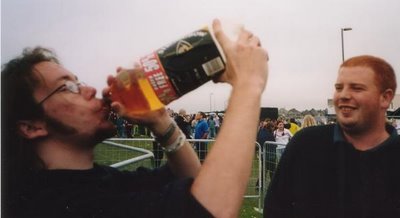
His webpage is becoming a guilty pleasure -- one I'd hoped to keep secret. But this week he took a swipe at Americans for the way we, like, talk, you know? So I had to engage.
OK, so he's technically right about our spelling and pronunciation of aluminum (or aluminium, as its known everywhere else in the world), but I mean, who cares? How often does this come up on conversation? I suppose if you're discussing the tensile strength of varying sized containers of Strongbow, it might be an issue. Anyway, I posted the following comment on his website.
Craig Winneker said...The Tippler, or Tony, as I know him, he's a good bloke and has a way with words when he's sober and even when he isn't, which is more than most of us can say. He replied cheerfully and hey, we're only havin' a bit o' fun.
um, i would make two points on your observations on American language:
1) what a crock of shit
2) check out Wikipedia's interesting entry on the subject, in which you will read that American English more closely resembles so-called Old English, before Norman Invasion changes spellings to use the superfluous "u" and ridiculous "s" instead of "z". In other words, you Brits are really speaking bastardized French.
Also, as an editor, you should abhor the British tendency to use seven words when one will do. We Americans have been streamlining, baby, yeah!
Ok, I'm done.

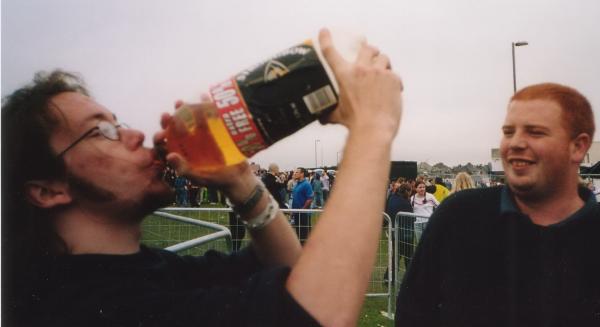
I'm eagerly awaiting a blog post from him explaining his mysterious switch from beer to cider... Scary...
Wednesday, September 20, 2006
Change Is Good
Big changes at TCS Daily, where I've been working as Europe Editor since 2002. The website has been sold by DCI Group to its editor, Nick Schulz. For more on the story, see Nick's article here, and DCI's press release here.
Nick is a brilliant editor and a great human being. I know he'll build on the success he's already made of TCS. Jim Glassman, the founder of TCS and a friend and mentor to me since our days at Roll Call, is now working on re-launching The American Enterprise magazine as The American. This is going to be really big -- everything Jim touches turns to gold.
I'm leaving the TCS staff but will continue as a contributor. I hope to make something more of the blog you're now reading in the coming weeks and months, but I'm also working hard on a new project called ThisEurope. Check it out, and sign up for updates!
Nick is a brilliant editor and a great human being. I know he'll build on the success he's already made of TCS. Jim Glassman, the founder of TCS and a friend and mentor to me since our days at Roll Call, is now working on re-launching The American Enterprise magazine as The American. This is going to be really big -- everything Jim touches turns to gold.
I'm leaving the TCS staff but will continue as a contributor. I hope to make something more of the blog you're now reading in the coming weeks and months, but I'm also working hard on a new project called ThisEurope. Check it out, and sign up for updates!
Tuesday, September 19, 2006
Cool Meets Cool
Bart Simpson meets the White Stripes....
Maybe you've seen this before, but Flemish TV seems to have stopped buying "Simpsons" episodes about eight seasons ago... So it's new to me.
Maybe you've seen this before, but Flemish TV seems to have stopped buying "Simpsons" episodes about eight seasons ago... So it's new to me.
Friday, September 15, 2006
Critic's Corner
The Bulletin, Brussels' weekly expat magazine, has just published my short review of a very long book, William T. Vollmann's Europe Central. You can't read Bulletin articles online, so I post my original version below (this way you can read it without antiquated English spellings!).
Europe Central
William T. Vollmann
Alma Books Ltd. (£12.99)
800 pages
Reviewed by Craig Winneker
Confronted with a clear moral choice in the face of overwhelming and pervasive evil – submit and have a chance to live, or do the right thing and most certainly die – what would you do?
This was the stark question unfortunately faced by many Europeans in the first half of the 20th century. We all know what most chose. In his astounding new book, Europe Central, William T. Vollmann, perhaps America’s greatest unknown author, looks at Nazi Germany and Soviet Russia before, during and immediately after World War II, and tries to come to grips with why.
Among the real-life characters he portrays are Soviet composer Dimitri Shostakovich, who struggled to stay true to his art even as Stalinism exerted unrelenting political pressure on him and his loved ones; Field Marshal Friedrich Paulus, who commanded the German troops at Stalingrad and, against his better judgment, followed Hitler’s order to fight to the last man (but disobeyed the one dictating that he die rather than surrender); and SS ‘hygiene’ officer Kurt Gerstein, who, while participating in the mass killing of Jews in several concentration camps, secretly tried to alert a Swedish diplomat and the Catholic Church to the Holocaust as it was happening.
Also featured: Russian documentary filmmaker Roman Karmen, German painter and sculptor Käthe Kollwitz, Russian General Andrei Vlasov, unsuccessful Lenin assassin Fanya Kaplan, and the mysterious muse Elena Konstaninovskaya. (Had he waited another year to finish the book, Vollmann might have thrown in a sensitive German teenager drafted by the Waffen SS who would go on to win a Nobel Prize for Literature and self-appointed moral arbiter of post-war Germany, all the while concealing his true background. No doubt he would have provided a more revealing analysis than we’ll get from Günter Grass’ new autobiography.)
In a structure that recalls John Dos Passos’ monumental U.S.A. trilogy (written before, during and after World War I), Vollmann weaves fictional and real characters throughout a series of short stories, and uses intimate personal experience to punctuate historical sweep. In an extensive notes section, he documents his fabrications as meticulously as his accuracies.
Winner of the National Book Award for fiction, Europe Central has brought a smattering of long-overdue fame to Vollmann, a prolific and immensely gifted writer whose works typically inhabit the world’s seedier realms and explore its darker issues. (Before publishing Europe Central he managed to abridge his seven-volume, 3,300-page attempt to devise a moral calculus for violence, Rising Up and Rising Down, to a somewhat more portable 750 pages.)
Europe Central has been available on these shores since May, albeit with much less attractive cover art than the US edition, which featured a stunningly stylized 1935 German poster, ‘Deutschland, das Land der Musik’; the European edition, with its helmeted German soldier and overflying bombers, resembles a military comic book.
Like its British equivalent, the Booker Prize, a National Book Award (not to mention the universally glowing reviews Vollmann has earned for this and nearly all of his other works) usually ensures bestseller status. But Europe Central’s sheer size and daunting subject matter no doubt turn readers away. Have no fear – choose to read it.
Europe Central
William T. Vollmann
Alma Books Ltd. (£12.99)
800 pages
Reviewed by Craig Winneker
Confronted with a clear moral choice in the face of overwhelming and pervasive evil – submit and have a chance to live, or do the right thing and most certainly die – what would you do?
This was the stark question unfortunately faced by many Europeans in the first half of the 20th century. We all know what most chose. In his astounding new book, Europe Central, William T. Vollmann, perhaps America’s greatest unknown author, looks at Nazi Germany and Soviet Russia before, during and immediately after World War II, and tries to come to grips with why.
Among the real-life characters he portrays are Soviet composer Dimitri Shostakovich, who struggled to stay true to his art even as Stalinism exerted unrelenting political pressure on him and his loved ones; Field Marshal Friedrich Paulus, who commanded the German troops at Stalingrad and, against his better judgment, followed Hitler’s order to fight to the last man (but disobeyed the one dictating that he die rather than surrender); and SS ‘hygiene’ officer Kurt Gerstein, who, while participating in the mass killing of Jews in several concentration camps, secretly tried to alert a Swedish diplomat and the Catholic Church to the Holocaust as it was happening.
Also featured: Russian documentary filmmaker Roman Karmen, German painter and sculptor Käthe Kollwitz, Russian General Andrei Vlasov, unsuccessful Lenin assassin Fanya Kaplan, and the mysterious muse Elena Konstaninovskaya. (Had he waited another year to finish the book, Vollmann might have thrown in a sensitive German teenager drafted by the Waffen SS who would go on to win a Nobel Prize for Literature and self-appointed moral arbiter of post-war Germany, all the while concealing his true background. No doubt he would have provided a more revealing analysis than we’ll get from Günter Grass’ new autobiography.)
In a structure that recalls John Dos Passos’ monumental U.S.A. trilogy (written before, during and after World War I), Vollmann weaves fictional and real characters throughout a series of short stories, and uses intimate personal experience to punctuate historical sweep. In an extensive notes section, he documents his fabrications as meticulously as his accuracies.
Winner of the National Book Award for fiction, Europe Central has brought a smattering of long-overdue fame to Vollmann, a prolific and immensely gifted writer whose works typically inhabit the world’s seedier realms and explore its darker issues. (Before publishing Europe Central he managed to abridge his seven-volume, 3,300-page attempt to devise a moral calculus for violence, Rising Up and Rising Down, to a somewhat more portable 750 pages.)
Europe Central has been available on these shores since May, albeit with much less attractive cover art than the US edition, which featured a stunningly stylized 1935 German poster, ‘Deutschland, das Land der Musik’; the European edition, with its helmeted German soldier and overflying bombers, resembles a military comic book.
Like its British equivalent, the Booker Prize, a National Book Award (not to mention the universally glowing reviews Vollmann has earned for this and nearly all of his other works) usually ensures bestseller status. But Europe Central’s sheer size and daunting subject matter no doubt turn readers away. Have no fear – choose to read it.
Friday, September 08, 2006
Europe's Economic Boom?
Occasionally I venture, oh so gingerly, into business journalism. Here I try my hand at analyzing recent European economic trends in a piece for TCS Daily. Caveat lector...
Thursday, September 07, 2006
Europe's Rising Stars
Tuesday, September 05, 2006
Rock and Roll Confidential
Chuck Prophet is a phenomenally gifted and criminally unknown guitarist and songwriter who's enjoyed critical success in his solo career (seven albums, each one better than the last). He's currently touring with his old mates in Green on Red, a mid-1980s band out of Tucson and L.A. that also weren't very well known but influenced a lot of alt.country, Americana and grunge-type bands that followed.
Green on Red have been playing club dates and festivals around Europe (where they have a small but loyal following of aging punkers and recovering hipsters). I saw their gig this week in the tiny town of Eeklo, Belgium. I made the hour-long drive from Brussels on a Sunday night to see them mainly because I'm a fan of Prophet's sublime albums and his right-on guitar picking. It was worth the trip: a great, garage-y rock show in a hot, sweaty venue. What more could you ask for?
Anyway, Chuck's keeping an online diary of the tour. It's funny and insightful -- and, like his songs, well-written. He talks about sharing a bill with Guns 'n' Roses, passes along some road-life culinary advice once given him by Exene Cervenka, and just generally riffs on being an itinerant rocker. Here's a sample entry.
Green on Red have been playing club dates and festivals around Europe (where they have a small but loyal following of aging punkers and recovering hipsters). I saw their gig this week in the tiny town of Eeklo, Belgium. I made the hour-long drive from Brussels on a Sunday night to see them mainly because I'm a fan of Prophet's sublime albums and his right-on guitar picking. It was worth the trip: a great, garage-y rock show in a hot, sweaty venue. What more could you ask for?
Anyway, Chuck's keeping an online diary of the tour. It's funny and insightful -- and, like his songs, well-written. He talks about sharing a bill with Guns 'n' Roses, passes along some road-life culinary advice once given him by Exene Cervenka, and just generally riffs on being an itinerant rocker. Here's a sample entry.
Wednesday, August 30, 2006
thisEurope on myspace.com!
What is thiseurope.com, you might well ask? Click here to find out, and to sign up for updates on our progress. Or, if you're a myspace kind of person, check out thiseurope on myspace.com...
Thursday, August 10, 2006
Europe's Greatest Speeches
Another bimonthly issue of e!Sharp magazine means another chance for me to conjure up a completely subjective Top Ten list. This time around I look at great speeches in European history. You can read the article (in .pdf format) by clicking here. Click here to take a look at the revamped e!Sharp website, which allows you to flip through the pages of the mag with a mouseclick. Pretty cool.
Tuesday, August 08, 2006
The Laser Beam Next Door
Here's the text of my Wall Street Journal Europe article on secret laser projects around the world. Enjoy!
Laser Tag
By CRAIG WINNEKER
August 4, 2006
I recently started my own blog because, like most normal people, I wanted to share various random and mundane thoughts -- as well as any Internet links to which they might correspond -- with anyone interested enough to stumble across them. Little did I know that some crude yet effective blogging technology would help me uncover a terrorist threat simmering simultaneously on every continent in the world.
You read it here first: A disturbing number of people are trying to build a laser gun.
It all began when I was still learning how to blog, tweaking the various features of my Web site to make them more attractive to the online passerby. Just for fun I posted a link to a page I'd come across that includes instructions for building a laser.
In case the existence of such a site worries you, rest assured that the required components for this particular model include a chain saw, a moped, 20 gallons of Vitalis and three cases of Pabst Blue Ribbon beer. It's likely to cause very little damage to anyone but the person attempting to build it. (The Web site, by the way, will also show you how to teach your monkey kung fu, build a time machine and, perhaps most usefully, make fruit salad.) I found it funny and figured others would, too. Hence the link.
Months went by without much happening -- at least in the way of people other than myself visiting my blog. Then, as I was figuring out how to configure my new Site Meter, a Web site hit counter, so that it would ignore my (quite frequent) hits on my own blog, I discovered something else. I could track individual visits to my page, discovering where the surfers were and what search terms they were using to reach me.
A few people were looking for strings of words I'd happened to have posted as titles with various articles I'd written. For example, researchers looking for the "top 10 European movies of all time" have been linking to a magazine article I wrote on the subject and subsequently stuck on my blog. Someone at the University of Leuven in Belgium was seeking "opinion on Interbrew choosing Stella Artois as a flagship brand"; typing those words into Google conjures my blog, where I'd posted a newspaper feature on beer marketing that provides said opinion.
Needless to say, I became obsessed with the people who were reading my site. I was stalking my would-be stalkers. Occasionally someone even searched on my name. That's always a bit spine-chilling -- but not as scary as what I found next. By far, the No. 1 search term bringing people to my Web site, thanks to the abovementioned blog entry, is "how to build a laser gun."
The first such link was from a browser in Terry, Mississippi. No big deal. Probably just some overachiever fed up with having to study intelligent design in school all day. But the next person was in Amman, Jordan. This caught my interest. We've become conditioned to fear the WMD-focused ambitions of people in the Middle East.
Then the next day there was a Web search from Madrid, Spain, where there had been a terror attack a few years ago and where there are still suspected al Qaeda cells. I was beginning to suspect a network. More hits followed, all looking for information on how to make laser guns.
Here's a partial list of hits and their origins: Kingston, Jamaica; Pierre, South Dakota; College Park, Maryland; Pendle Hills, Australia; Brooklyn, New York; Stafford, Virginia (home of Quantico Marine Base); Allahabad, India; Sao Paolo, Brazil; Kelaniya, Sri Lanka; Qiryat Gat, Israel; Lebanon (!), Tennessee.
Every day I check my site stats. About every third day I find someone looking to build a death ray.
Site Meter offers a few other intriguing clues about these would-be mad scientists, occasionally providing more detailed information. A visitor to my site from Abingdon, Oxfordshire, in the U.K., was searching from the premises of Research Machines, an educational software company. Another wasn't just from Maine: He or she was from the Maine Bureau of Taxation, raising disturbing questions about regulators run amok.
By the way, these people are not just searching "how to build a laser." They want to know "how to build a laser gun." The former search string will get you a couple of junior-college FAQ Web sites that tell you how to rig up a crude laser. Add "gun" and you get the original site I found so funny, a few online gaming forums and my blog.
You may say I'm crazy to be worried. But I'm stocking up on Vitalis and Pabst.
Mr. Winneker is a writer in Brussels. Check out his blog at http://www.craigwinneker.com. If you want to know how to build a laser gun, visit www.wwujd.com/makealaser.htm.
Copyright 2006 Dow Jones & Company, Inc.
Laser Tag
By CRAIG WINNEKER
August 4, 2006
I recently started my own blog because, like most normal people, I wanted to share various random and mundane thoughts -- as well as any Internet links to which they might correspond -- with anyone interested enough to stumble across them. Little did I know that some crude yet effective blogging technology would help me uncover a terrorist threat simmering simultaneously on every continent in the world.
You read it here first: A disturbing number of people are trying to build a laser gun.
It all began when I was still learning how to blog, tweaking the various features of my Web site to make them more attractive to the online passerby. Just for fun I posted a link to a page I'd come across that includes instructions for building a laser.
In case the existence of such a site worries you, rest assured that the required components for this particular model include a chain saw, a moped, 20 gallons of Vitalis and three cases of Pabst Blue Ribbon beer. It's likely to cause very little damage to anyone but the person attempting to build it. (The Web site, by the way, will also show you how to teach your monkey kung fu, build a time machine and, perhaps most usefully, make fruit salad.) I found it funny and figured others would, too. Hence the link.
Months went by without much happening -- at least in the way of people other than myself visiting my blog. Then, as I was figuring out how to configure my new Site Meter, a Web site hit counter, so that it would ignore my (quite frequent) hits on my own blog, I discovered something else. I could track individual visits to my page, discovering where the surfers were and what search terms they were using to reach me.
A few people were looking for strings of words I'd happened to have posted as titles with various articles I'd written. For example, researchers looking for the "top 10 European movies of all time" have been linking to a magazine article I wrote on the subject and subsequently stuck on my blog. Someone at the University of Leuven in Belgium was seeking "opinion on Interbrew choosing Stella Artois as a flagship brand"; typing those words into Google conjures my blog, where I'd posted a newspaper feature on beer marketing that provides said opinion.
Needless to say, I became obsessed with the people who were reading my site. I was stalking my would-be stalkers. Occasionally someone even searched on my name. That's always a bit spine-chilling -- but not as scary as what I found next. By far, the No. 1 search term bringing people to my Web site, thanks to the abovementioned blog entry, is "how to build a laser gun."
The first such link was from a browser in Terry, Mississippi. No big deal. Probably just some overachiever fed up with having to study intelligent design in school all day. But the next person was in Amman, Jordan. This caught my interest. We've become conditioned to fear the WMD-focused ambitions of people in the Middle East.
Then the next day there was a Web search from Madrid, Spain, where there had been a terror attack a few years ago and where there are still suspected al Qaeda cells. I was beginning to suspect a network. More hits followed, all looking for information on how to make laser guns.
Here's a partial list of hits and their origins: Kingston, Jamaica; Pierre, South Dakota; College Park, Maryland; Pendle Hills, Australia; Brooklyn, New York; Stafford, Virginia (home of Quantico Marine Base); Allahabad, India; Sao Paolo, Brazil; Kelaniya, Sri Lanka; Qiryat Gat, Israel; Lebanon (!), Tennessee.
Every day I check my site stats. About every third day I find someone looking to build a death ray.
Site Meter offers a few other intriguing clues about these would-be mad scientists, occasionally providing more detailed information. A visitor to my site from Abingdon, Oxfordshire, in the U.K., was searching from the premises of Research Machines, an educational software company. Another wasn't just from Maine: He or she was from the Maine Bureau of Taxation, raising disturbing questions about regulators run amok.
By the way, these people are not just searching "how to build a laser." They want to know "how to build a laser gun." The former search string will get you a couple of junior-college FAQ Web sites that tell you how to rig up a crude laser. Add "gun" and you get the original site I found so funny, a few online gaming forums and my blog.
You may say I'm crazy to be worried. But I'm stocking up on Vitalis and Pabst.
Mr. Winneker is a writer in Brussels. Check out his blog at http://www.craigwinneker.com. If you want to know how to build a laser gun, visit www.wwujd.com/makealaser.htm.
Copyright 2006 Dow Jones & Company, Inc.
Subscribe to:
Posts (Atom)


